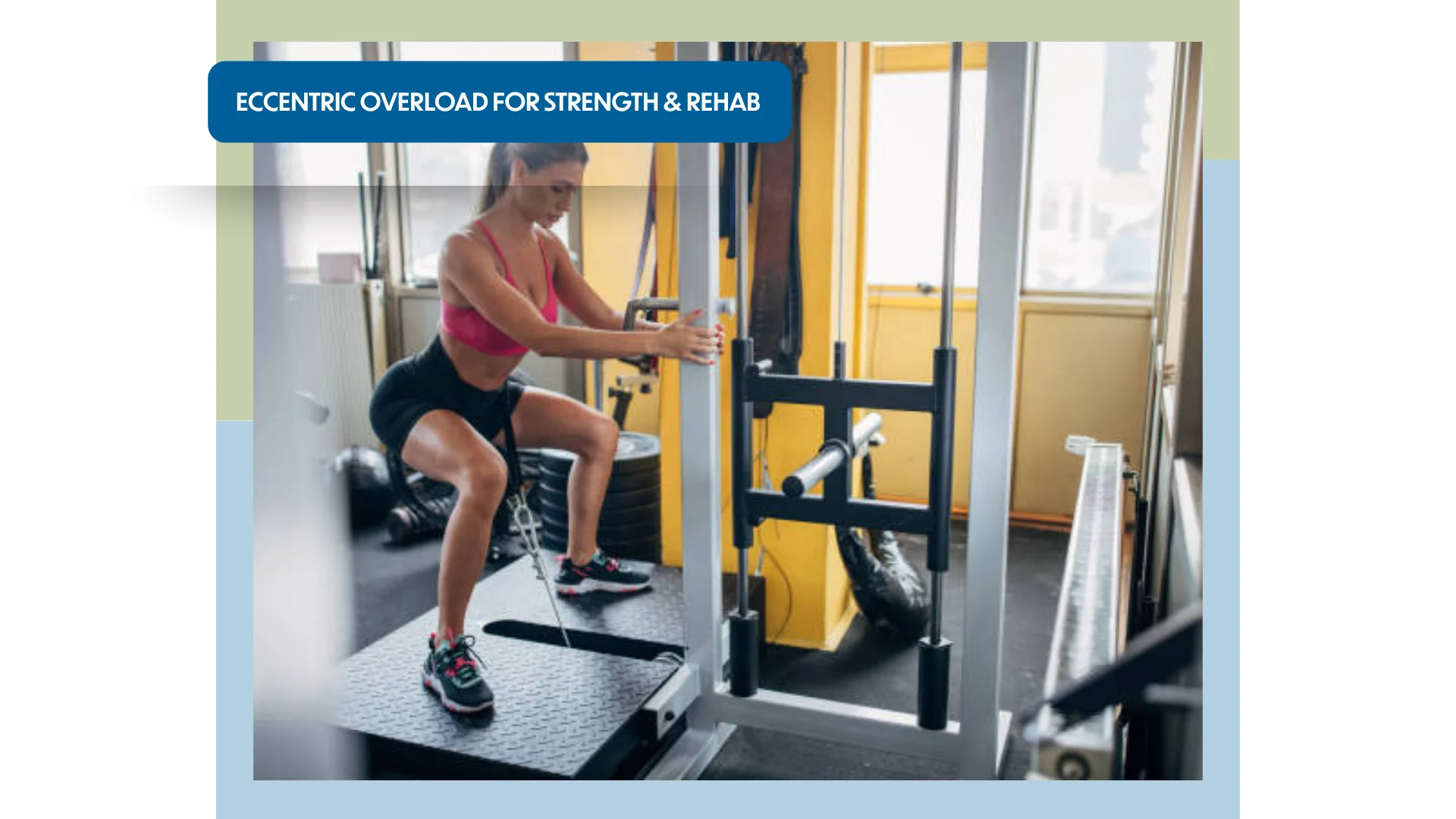
For centuries, strength training has relied on the constant force of gravity. Barbells, dumbbells, and kettlebells all challenge the body by pulling downward, with resistance limited to the mass being lifted. But what happens when resistance is no longer dictated by gravity?
Enter flywheel training, a method born out of space research that has steadily gained traction in performance and rehabilitation circles. By replacing static weights with a rotating flywheel that resists acceleration and demands controlled deceleration, this system introduces a unique twist: the ability to safely overload the eccentric (lowering) phase of a movement in ways that conventional tools cannot. This single feature has far-reaching implications for hypertrophy, strength, rehabilitation, and athletic performance.
How Flywheel Training Works
A typical flywheel device consists of a strap wound around a rotating disk. When you exert force, for instance by pulling the strap or squatting against the system, the disk spins faster and stores energy. On the return phase of the movement, the stored energy in the disk pulls the strap back, forcing your muscles to resist the momentum. This is the key principle: the harder you push concentrically, the greater the challenge eccentrically.
This variable resistance means the system instantly adapts to your output. There are no pre-set weights, only the intensity you create with your own effort. As a result, every single repetition matches your capacity, ensuring that your muscles are consistently challenged throughout the full range of motion.
The Science of Eccentric Overload
The eccentric phase of a movement—when muscles lengthen under tension—is where some of the most powerful muscular adaptations occur. Muscles can produce greater force eccentrically than they can concentrically, yet traditional weights rarely allow us to safely exploit this. For example, you might be able to squat 100 kg, but you would struggle to lower 130 kg under control.
Flywheel training solves this problem by naturally amplifying the eccentric phase. When you give maximum effort in the concentric phase, the stored energy in the flywheel demands an equally high effort eccentrically. This creates microtears that stimulate muscle hypertrophy, enhances tendon stiffness, and develops strength qualities that are highly transferable to sports. Athletes often report greater explosiveness after incorporating flywheel training because eccentric control directly improves the stretch-shortening cycle, which is the foundation of sprinting, jumping, and cutting movements.
Applications in Performance and Rehab
Flywheel devices first gained attention from NASA, as astronauts needed a way to maintain muscle and bone mass in zero gravity. Today, their applications are much broader.
Sports performance:
Flywheel training is used to increase power output, improve sprint mechanics, and enhance change-of-direction ability. Athletes in sports like soccer, basketball, and rugby frequently use it to gain a competitive edge.Rehabilitation:
The adjustable, responsive resistance of flywheel training makes it ideal for controlled loading during injury recovery. It is particularly effective for tendon-related issues such as patellar or Achilles tendinopathy.General population:
While once limited to elite athletes, smaller, more portable flywheel devices have made this training accessible to recreational lifters, offering a joint-friendly yet highly effective strength stimulus.
Comparing Flywheel to Free Weights
Free weights will always have their place in training. They are essential for building foundational strength, allowing for maximal loading, and carry a long tradition of effectiveness. Flywheel training doesn’t replace free weights; it complements them.
The key differences between the two methods are:
Variable vs. fixed resistance:
Flywheels scale their resistance to your effort, while free weights provide constant, fixed resistance.Eccentric overload:
Flywheels naturally emphasize eccentric overload, whereas free weights require advanced techniques and often a spotter to achieve it safely.Practicality:
Free weights require a lot of space and multiple plates, while flywheels are compact but often more expensive.
A well-balanced training program may combine both. You could use heavy barbell lifts for raw strength development and flywheel work for eccentric development and explosive power transfer.
Limitations and Considerations
While powerful, flywheel training isn’t without its drawbacks. The cost of quality devices can be prohibitive for home users. There is also a learning curve. Without proper coaching, athletes may overexert eccentrically and increase their risk of soreness or injury. Finally, certain exercises, like very heavy squats or deadlifts, still benefit from traditional loading, which flywheels can’t replicate perfectly. That said, for athletic teams, rehab clinics, and individuals seeking a compact, science-backed tool, the benefits often outweigh these limitations.
Conclusion: The Future of Resistance Training
Flywheel training represents a significant shift in how we think about strength. By unlocking eccentric overload and matching resistance to effort, it delivers a training stimulus that is both highly adaptive and effective. From astronauts to elite athletes and everyday lifters, its impact continues to expand. It doesn’t aim to replace barbells or dumbbells; it simply offers something they can’t. In doing so, it reminds us that the evolution of strength training isn’t about discarding the old, but about refining how we challenge the body to grow stronger, faster, and more resilient.
Summary
This blog post explains the principles of flywheel training, a method of resistance exercise that uses a rotating disk to create variable resistance. It highlights that the unique benefit of this system is its ability to naturally and safely overload the eccentric (lowering) phase of a movement, which is crucial for building strength and promoting muscle growth. The article discusses how flywheel training originated with NASA to help astronauts maintain muscle mass in zero gravity and is now used in sports performance and rehabilitation. It also compares flywheel training to traditional free weights, noting that flywheel training complements free weights rather than replacing them , and points out some limitations such as cost and the learning curve.
Ready to get stronger, faster, and more resilient?
Join us on Sunday October 26th, 2025 for a Spooktackular new run at Bronte Creek Provincial Park! We have registered a team for “Haunted Hustle” under InnerStrong. Join us today to take on a new challenge and build your strength in a fun, supportive environment.
Register here: https://www.hauntedhustle.ca/
Looking for a new approach to your training?
Book a discovery call with me to learn how we can integrate innovative methods like eccentric overload training into a personalized program designed to help you reach your goals.